
Joshua Ryu
Matthew 11:1-15
Early January, I was catching up with my childhood friend. He and I grew up together and even did ministry together for a long time. He is a deacon now.
After returning to Toronto, I was so busy unpacking that I couldn’t reach out. This year, I wanted to make sure I could spend time with him in fellowship.
But to my surprise, he was going through a rough season.
And how he described his difficult season pressed heavily on my heart. He said,
· “Josh, lately, I don’t see the Kingdom of God at work in my life.”
Objectively, he is a faithful Christian. And knowing him well over all these years, I know he loves the Lord and follows him wholeheartedly.
So, hearing him say he doesn’t feel or see the Kingdom of God at work in him, I sensed the weight of trouble that he has encountered.
Church, as we journey in Christ, we can reasonably assume that all of us, too, at one point, share the same sentiment.
We know Jesus made us new. We know the truth of the Gospel. We are assured of our salvation in Christ.
· But it is often when we are most vulnerable, most broken, and most wounded by life’s greatest challenges,
· we find ourselves questioning Jesus, wrestling with doubt, and giving way to fear.
· Church, this is not to say these are wrong; questioning, doubt, and even fear are often part of an honest journey of faith.
And in our passage today, the last prophet, known as John the Baptist, was facing a similar spiritual crisis.
His calling was to prophesy the coming Messiah—the last prophet. He was to wait upon the Lord and his Kingdom—that was his life's mission.
And he finally meets the Lamb of God. In fact, he even baptized Jesus to fulfill the prophecy of the old: Malachi 3:1+Matthew 11:10, to prepare the way of the Lord.
· See, God used John to open the hearts of the people, preparing them for the salvation that would come through Jesus and his Kingdom.
But now, he is in trouble. Courageous man that he was, he had publicly rebuked Herod Antipas, the ruler of Galilee, for his marital affairs.
History teaches us that Herod had visited his brother in Rome and seduced his wife. He had then divorced his own wife and lured his sister-in-law to leave her husband and marry him.
This was, of course, unlawful.
So John had denounced this behaviour, and paid the penalty—he was thrown into prison,
· prison in the fortress of Machaerus in the burning mountains by the Dead Sea.
Though uncertainty about his future brought despair, his spirit was not yet fully broken, for John had found the Messiah—that was what kept him strong in prison.
But as V2 testifies to us, when he heard about what Jesus was doing, John was confused.
You see, John the Baptist was an Old Testament guy. By that, I mean John the Baptist operated within an Old Testament framework; his theology and messianic expectations were formed by the Hebrew Scriptures.
· So, like most Israelites at the time, he anticipated a politically powerful Messiah who would defeat Roman rule, establish justice, and restore the glory of Israel once again.
But that’s not what Jesus was doing: wedding party, turned water into wine, he ate with sinners, and sometimes he even broke the law and tradition.
So in prison, in the place of loneliness and disappointment, John begins to question and doubt Jesus.
· Is this the right guy? Where is his Kingdom?
If this doubt can befall the last prophet, I am convinced it can befall us on our journey with Jesus.
So, church, when the Kingdom of God feels far away, even irrelevant, how can we wrestle with doubt while still honoring Jesus? What does Jesus say—how does he encourage John in our passage?
I find incredible encouragement from Jesus, but it's through unusual words in V12.
ESV—From the days of John the Baptist until now the Kingdom of heaven has suffered violence, and the violent take it by force.
CEB—From the days of John the Baptist until now the Kingdom of heaven is violently attacked as violent people seize it.
Let us unpack the teaching of Jesus together so that we may also be encouraged by Christ.
1. The expectation of Conflict of the Kingdom of Heaven.
12a From the days of John the Baptist until now the Kingdom of heaven has suffered violence
The Kingdom of heaven has suffered violence.
The phrase suffered violence comes from one Greek word, “βιάζεται.”
This word is quite tricky to translate in our passage.
If it's used in the middle voice, the meaning shifts to "the Kingdom of heaven is marching strongly or forcefully."
· Whereas, if it's used in passive voice, the meaning changes to the Kingdom of heaven is violently attacked.
· That’s quite a swing.
So, to understand what Jesus means here, we cannot rely solely on Greek grammar. Instead, we need to consider the passage in its entirety to grasp His intended meaning.
As we can see, the context and timing of this passage focus not on Jesus’ triumph ministry, but on John the Baptist’s imprisonment. And Jesus makes it clear that the violent attack on the Kingdom of heaven began from the days of John the Baptist—it signals the arrival of the Kingdom.
In that regard, ESV accurately translates this verse:
12a From the days of John the Baptist until now the Kingdom of heaven has suffered violence
Well, what does that mean? Why is there an attack? And how does this encourage John?
When Jesus was tempted by Satan, in the 2nd temptation, Satan says something very interesting
Luke 4:5-7 ESV
5 And the devil took him up and showed him all the kingdoms of the world in a moment of time, 6 and said to him, “To you I will give all this authority and their glory, for it has been delivered to me, and I give it to whom I will. 7 If you, then, will worship me, it will all be yours.”
This teaches us that when Adam and Eve allowed sin to enter the creation of God, they exchanged the power and authority that God entrusted to them to rule the world with sin.
· And now the evil one carries that power and authority. He has the power of the dominion in which we live. This is why he could offer J
Let’s go back.
When John the Baptist preached in the wilderness, calling people to repent, for the Kingdom of God is near, the Kingdom began to manifest itself in concrete reality.
As John preached repentance, people responded to his message, and the Kingdom of heaven began to take shape in the words and lives of those whose hearts were turned.
This is where the clash between the Kingdom of Heaven and the dominion of the evil one began.
You see, when the Kingdom of heaven exists only as words and concepts, those who hold power in the world, the one that Paul calls it as the ruler of the Kingdom of the air in Ephesians, do not feel particularly threatened.
· But when the Kingdom of Heaven manifests in his dominion, it becomes his business.
Church, the same is true for you and me. When the Gospel transforms us and bears fruit in our lives—when forgiveness is practiced, repentance is sincere, and God’s grace and love overflow—that is when the Kingdom of God takes shape in our reality.
And yes, there will be pushback. There will be some conflict.
It may even be difficult—It was for John.:
From his prison cell, John asks, ‘Are you the one who is to come? The final prophet, who once proclaimed the Messiah with such power and passion, now finds himself shaken in the darkness.
But here is the good news: Jesus does not rebuke him for his doubt and weakness. Instead, Jesus reassures the trust that John had in him:
· Hey John, Look—through your faith/trust, the Kingdom has come: the blind receive sight, the lame walk, and the good news is proclaimed. You are being my vessel.
Church, perhaps you are walking through a difficult season, feeling alone and wounded. Yet today’s passage assures us that even then, the Gospel never stops moving in us.
In your brokenness, in your wounded, shattered, and cracked heart, it overflows with the Kingdom of heaven.
· Your tears, perseverance, prayers, and even simple obedience will not go to waste. It will all be used for the Kingdom of Heaven and His glory, even when you doubt/broken.
You know, church, when I was meditating on this passage, the encouragement that I received from the Lord was incredible, and I want to share it with you, but my words are limited. God, I am not articulate enough to reveal what you have shown me. So I was praying:
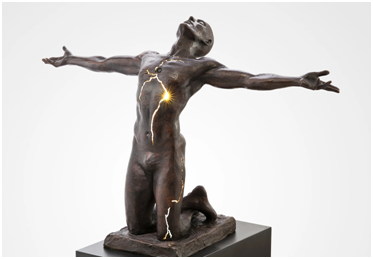
Even our broken, shattered, and cracked hearts can bring the beauty of Christ when the Gospel overflows within us, when the Kingdom overflows through us.
When I first saw these images, my mind immediately went to Job—how God proudly presented him before the heavenly court.
· Can you imagine the Lord looking upon us with that same pride, saying, “Do you see my son? Do you see my daughter? Do you see my church, NHF DT? Look at how they are embodying and displaying my Kingdom.”
· Church, be encouraged today because God is pleased. He is proud of the way you are living out and reflecting His Kingdom. broken
Because we trust in Jesus/the Gospel brought transformation, there will be conflict—we need to know this. But fear not, even in our doubt and weakness, the Lord sees His Kingdom being manifest through you, and he is pleased.
2. The Expectation of a Forceful Inbreaking of the Kingdom of Heaven
Now, if we end here with passive voice alone, we run into problematic translation. V12
ESV—From the days of John the Baptist until now the Kingdom of heaven has suffered violence, and the violent take it by force.
CEB—From the days of John the Baptist until now the Kingdom of heaven is violently attacked as violent people seize it.
So, if we take βιάζεται as passive voice, it translates as 'those who attack the Kingdom will take it from us.
Well, can anyone take the Kingdom of heaven away from us with violence?
When John the Baptist was imprisoned, was the Kingdom of God taken away from him?
When Paul was beheaded for proclaiming the Gospel, did he lose the Kingdom of God?”
· The answer is No.
You can imprison the messenger, but you cannot imprison the Kingdom of God once it has been proclaimed.
· You can crucify Jesus, but you cannot stop the resurrection.
Church, this is the promise of our salvation in the Gospel. The work that Jesus completed, no one can take that away from us. Amen?
So, if the Kingdom of God cannot be taken away from us, how do we reconcile with the verse when it says, as violent people seize it? This is where we need βιάζεται to be a middle voice.
If the clash between the Kingdom of Heaven and the dominion of the evil one is inevitable, and if we—the believers and the Church—are steadfast upon our trust in Jesus from the time of John the Baptist, then we also need to recognize that the dominion of the evil one is now under attack.
· Through our faith, the Kingdom of Heaven is the one marching strongly into this dominion.
· βιάζετα functions like two sides of a coin
· Since the time of John the Baptist, yes, the Kingdom of Heaven has been attacked.
· But through the Gospel work of Jesus, we now march with His Kingdom here on earth.
Well, how do we do that? How do we march with the Kingdom of God?
Do we violently take it? Do we defeat the evil one?
Do we grab spiritual guns and knives and fight the evil one? Sometimes I wish we could.
· But Pastor John taught us that we don’t worship God with our imagination, but with revelation.
So, what does Jesus reveal to us in our passage?
How does He expect us to march with the Kingdom of God?
Jesus answers us in V5, and it’s no secret:
5 the blind receive their sight and the lame walk, lepers are cleansed and the deaf hear, and the dead are raised up, and the poor have good news preached to them.
If I can summarize V5, it’s the Gospel. Jesus is not asking us to perform miracles and heal people. Instead, he wants us to live with the Gospel so that others may see the Kingdom of Heaven—healed.
Church, Christians need the gospel as much as non-Christians do.
Pastor Tim Keller taught that the gospel is not merely a "diving board" or "jumping-off point" to enter Christianity, but rather the "swimming pool" itself—the entire context in which Christians live, grow, and operate.
Accordingly, the Gospel is not merely the doorway into Christianity; it is the path we walk every day as believers.
· The Gospel shapes our whole life, our whole faith, and our whole journey with the Lord.
Now, if this is true, then the Gospel must be at work even in times of crisis—when we are most vulnerable, most broken, and most wounded.
· Yet so often, in those very moments, we find ourselves turning to other things, other ways, and other means to try to rescue ourselves.
That was the case for John—are you the one? Should I look for another?
So, as Jesus encourages John to let him know that the Lord is pleased with him, but simultaneously, in the same verse, gently yet firmly, Jesus also challenges him:
· Hey John, do not stop now. Keep marching forward with My Kingdom—the Kingdom you have already proclaimed through the Gospel.
· Continue to let the Gospel overflow from your life, so that the Kingdom of Heaven may take its rightful place on the earth.
And Church, I want to encourage you that you are doing this!
Over the past 30+ days, I have been deeply inspired by this church and by each of you.
As a new member, I have witnessed the Kingdom of Heaven made visible through your willingness to walk with the Gospel in the midst of every challenge brought by this unexpected flood.
You supported one another. You shared. You loved. You praised. You prayed. You built. You gathered.
· Watching you live out the Gospel and reflect the Kingdom of God here on earth has been deeply refreshing to my soul.
So today, I want to thank you, for showing me His Kingdom. And just as Jesus challenged John, I now want to challenge you gently:
Church, Continue to be living testimonies of the Gospel. Continue to be the inspiration of the Gospel to others.
Your every act, every word, and every step you take with the Gospel makes a difference.
And may we together seize the Kingdom of Heaven right here, in the heart of Toronto.
